
Minting and burning tokens
You are looking at an old version of this page: revision #1072 by zoobc.how, 2026-10-27 00:42 UTC. See the current version
A user token's supply can change after its issue only if its issuer allowed it. A mintable token lets its issuer add units later; a redeemable token lets any holder burn units and take back their share of the token's ZBC backing. Both operations keep the backing fair: neither can lower the backing per unit for the holders who stay.
Minting: MintToken
MintToken (type 12) adds units to a token's supply. Only the issuer may mint, and only a mintable token. The minter must add backing at the token's current ratio, rounded up against the minter:
backing added = ceil( amount × backing ÷ supply )A token without backing therefore takes no backing when it is minted. A token issued by a member of an account group belongs to the group, and any member enabled to send for the group may mint it.
Burning: BurnToken
BurnToken (type 13) destroys units, and only units that the sender holds: nobody can burn tokens held by another account. It works only on a redeemable token. A burn of any other token is refused, and is a paid no-op if a block includes it anyway. The burner receives the burned units' share of the backing, rounded down and never more than the backing:
ZBC returned = floor( amount × backing ÷ supply )The ZBC comes from the token's own backing, not from the issuer's balance.
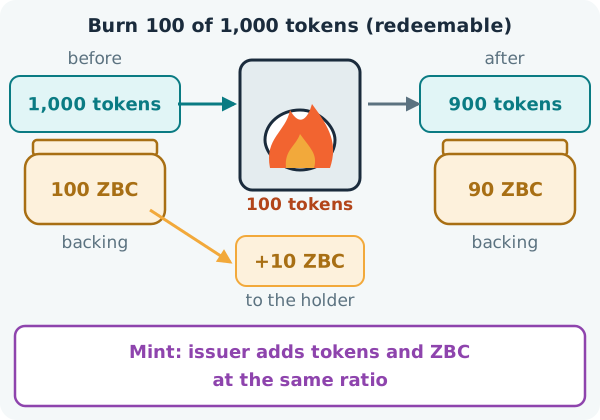
Rounding favours the other holders
Minting rounds up what the minter pays in, and burning rounds down what the burner takes out. With amounts counted in atomic units, the effect is easy to see:
Either way, what remains per unit for the other holders does not fall. Paying a transfer's fee in the token follows the same direction: the units it gives up are rounded up (see issuing a token).
What cannot be minted or burned
- ZBC. ZBC is not a token, and no token transaction can mint or burn it. ZBC is never burned at all: penalties, such as the 10 % of a node's lock lost on expulsion, and the dust of accounts pruned for rent go to the longevity pool, which pays the nodes (see ZBC is never burned). The chain's tally of burned ZBC stays at zero, while burns of user tokens and of bridge coins are counted.
- Genesis coins. They are neither mintable nor redeemable, so a MintToken or BurnToken on them is refused, and is a paid no-op if a block includes it. The supply of the four bridge coins changes only through bridge and wrapped coins.
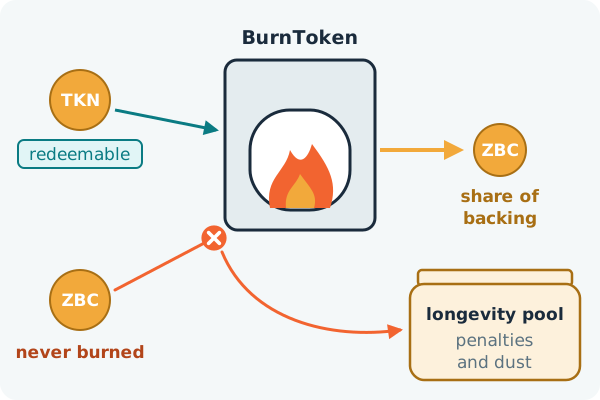
Minting, burning and upkeep
MintToken and BurnToken can carry a survival payment that extends the token's life (see token upkeep (persistence)). When a token expires without upkeep, its remaining backing is shared among its holders in proportion to their units: the last way, besides burning, in which backing returns to holders.