
Proof of Participation compared with PoW and PoS
You are looking at an old version of this page: revision #56 by zoobc.how, 2026-10-26 20:39 UTC. See the current version
Every blockchain has to decide who writes the next block. Proof of Work gives the right to whoever spends the most computing power, Proof of Stake to whoever stakes the most coins. Delegated and federated designs hand it to an elected or approved group. Proof of Participation (PoP), ZooBC's consensus, gives every admitted seat the same chance, admits new seats slowly at a pace the protocol sets, and pays for measured work. This page sets the designs side by side.
Who makes the blocks
| Proof of Work | Proof of Stake | Delegated / federated | Proof of Participation | |
|---|---|---|---|---|
| A producer's chance follows | hash power | coins staked | being elected or approved | one equal share per active seat |
| More power comes from | buying hardware | buying coins | winning votes, being appointed | more seats, admitted one per cycle |
| Who may become a producer | anyone with hardware | anyone with coins | the elected or listed few | anyone who locks a stake and waits in the queue |
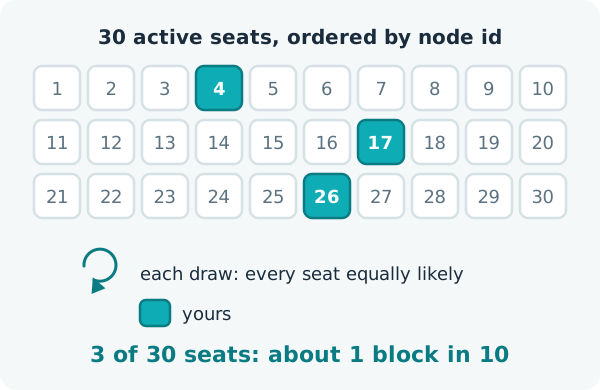
In Proof of Work and Proof of Stake, power can be bought as fast as money allows: hardware in one case, coins in the other. In Proof of Participation every active, non-suspended seat of the node registry has the same chance in the draw for each block. Hardware, account balance, stake and even the node's participation score do not enter the draw. An operator holding 3 of 30 seats makes about one block in ten.
Open, but paced
Delegated designs concentrate block production in a few elected producers, federated designs in a fixed list of known validators. Proof of Participation keeps the producer set open and flat.
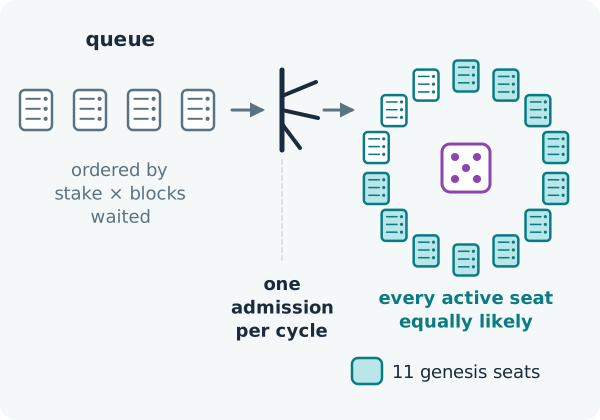
Open. Any owner account can register a node key and lock at least the queue minimum, which starts at 100 ZBC on mainnet; the seats can vote it anywhere between one atomic unit and 250 ZBC. Nobody votes applicants in, and no foundation approves them. Each chain starts from 11 genesis seats held by the ZooBC Foundation and grows only through the queue.
Paced. The queue is ordered by stake multiplied by blocks waited, and the protocol admits one node per cycle. A cycle is 600 days divided by the number of seats, kept between 7 and 90 days: about 54.5 days with 11 seats. The first newcomer joins 7 days after genesis. See admission pace.
Flat. Once admitted, a seat is a seat. A larger stake buys an earlier place in the queue, never more blocks: to pass an applicant who has waited ten times longer, an applicant must lock ten times more.
The price of paced membership is slow growth. While the 600-day base sets the pace, the registry takes about 416 days to double, whatever its size. An attacker faces the same pace: seats cannot be bought overnight (see what Proof of Participation defends against).
What keeps a seat
In Proof of Participation a seat is not kept by money: it is kept only by doing the work, producing at its turns and relaying blocks and transactions to its assigned peers. A node that skips turns earns nothing and loses participation score, and at zero it is expelled (see missed turns, suspension and expulsion). The stake is a bond: it earns nothing by itself, and there is no staking interest.
What makes a block hard to fake
In Proof of Work a block is hard to fake because it embodies work that is expensive to redo. Proof of Participation spends no energy on puzzles; its design calls this "no wasted work". A ZooBC block is signed with the key of a node drawn for its round, and it carries a seed that only that key could produce (see block seed (VRF)). Every node checks both, along with every transaction and receipt in the block. Security rests on Ed25519 signatures, the SHA3-256 hash and a verifiable random function. Computing power plays no part, and an empty block is perfectly valid.
Rewards and finality
New ZBC comes only from the coinbase, shared every block by a lottery weighted by participation score, not by stake or hash power (see coinbase lottery). There is no bonus for making a block.
Proof of Work offers probabilistic finality: Bitcoin users often wait six blocks before they treat a payment as settled. ZooBC sets hard limits instead: no node rolls back more than 720 blocks (3 hours), and none goes below the last checkpoint co-signed by two thirds of the seats (see finality and rollback).