
Tokens and markets
You are looking at an old version of this page: revision #1088 by zoobc.how, 2026-10-27 00:42 UTC. See the current version
ZooBC builds tokens and trading into the protocol. Issuing a token, sending it, swapping it and placing an order on a market are ordinary transaction types with fixed rules, so nobody writes contract code and every node applies them in the same way. Every balance of every asset counts in atomic units of 10⁻⁸: one ZBC is 100,000,000 of them, and so is one whole unit of any token.
Three kinds of asset
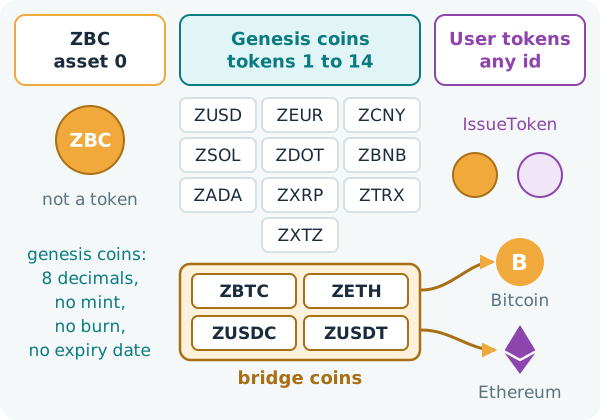
- ZBC is asset 0, the chain's own coin (see ZBC coin and its units). It is not a token: its balance is the account balance. No token transaction can mint or burn it, new ZBC comes only from the coinbase, and it never expires. ZBC is never burned at all (see ZBC is never burned).
- Genesis coins are tokens 1 to 14, written by block 0: ZUSD, ZEUR, ZCNY, ZBTC, ZETH, ZSOL, ZDOT, ZBNB, ZADA, ZXRP, ZTRX, ZXTZ, ZUSDC and ZUSDT. Their names say what they stand for, such as "Zoo US Dollar" for ZUSD and "Zoo Bitcoin" for ZBTC. All have 8 decimals and were created without an expiry date, so no upkeep is due for them. They are neither mintable nor redeemable: a MintToken or BurnToken on them is refused, and is a paid no-op if a block includes it anyway.
- User tokens are issued by anyone with an IssueToken transaction, and identified by the id of that transaction (see issuing a token).
Four genesis coins are bridge coins: ZBTC (bitcoin), ZETH (ether), and ZUSDC and ZUSDT (ERC-20 tokens on Ethereum). Each has a custody address fixed in the genesis, and its supply changes only through bridge and wrapped coins. The other ten genesis coins have no custody address.
Using tokens
- Decimals and the step: how many of the 8 decimal places a token uses, and the step every amount must respect.
- Issuing a token: IssueToken, the rules for symbols and names, ZBC backing, and TransferToken.
- Minting and burning tokens: adding supply, and redeeming units for their share of the backing.
- Token upkeep (persistence): the free first period, and the survival payments that keep a token alive.
- Split and transact policies: split policies that share incoming money, and transact policies that refuse whole categories of transactions.
Token units can also be held in an escrow, streamed as a liquid payment or paid out by a schedule.
Trading
- Swap offers: all-or-nothing trades between any two assets.
- Markets and orders: on-chain order books, matched by every node in the same way.
- The bridge and wrapped coins: how bitcoin and ether become ZBTC and ZETH on ZooBC, and back.
Matching is part of consensus, so no operator holds the traders' funds or can reorder the book. ZooBC has no automated market-maker pools: trades happen between offers and orders that people place.
The event attestations that the bridge relies on are explained in triggers and attestations.
See also
Articles in this topic
- Decimals and the step
What a ZooBC token's decimals mean, the step that every amount of the token must be a multiple of, and where the decimals matter for trading. - Issuing a token
How to create a token on ZooBC with one IssueToken transaction, the rules for its symbol and name, its ZBC backing and its id, and how its units move with TransferToken. - Markets and orders
How ZooBC's on-chain order books work: opening a market, placing and matching orders, the taker fee, and the rent that keeps a market open. - Minting and burning tokens
How the issuer of a mintable ZooBC token adds supply with matching ZBC backing, and how holders of a redeemable token burn units for their share of it. - Split and transact policies
How a ZooBC account can share every incoming credit automatically with a split policy, and refuse whole categories of transactions with a transact policy. - Swap offers
How a ZooBC swap offer trades any two assets: the maker locks what it gives, and a single taker pays exactly what the maker wants, all or nothing. - The bridge and wrapped coins
How ZooBC's bridge turns bitcoin, ether and two Ethereum stablecoins into wrapped coins on ZooBC and back, by votes of the registered nodes. - Token upkeep (persistence)
How long a ZooBC user token lives, how survival payments from anyone extend it, and what happens to its holders and its ZBC backing when it expires.