
The ZBC coin and its units
You are looking at an old version of this page: revision #98 by zoobc.how, 2026-10-26 20:39 UTC. See the current version
ZBC is the native coin of ZooBC. It pays for everything the chain does for you: the fee of each transaction, the stake a node locks to join the registry, and the rent that keeps accounts and data on the chain. On the chain itself ZBC has no decimals at all: every amount is a whole number of atomic units.
Atomic units
One ZBC is 100,000,000 atomic units, so ZBC has eight decimal places and the smallest amount is 0.00000001 ZBC. It is the same scale Bitcoin uses for its satoshi.
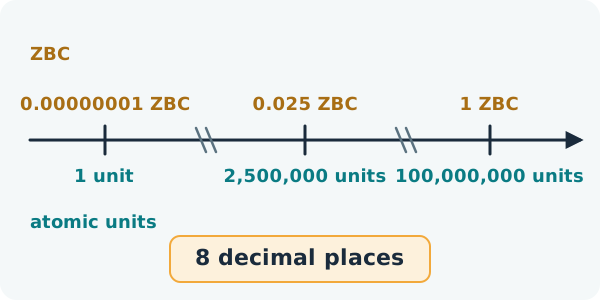
Inside a transaction, every amount, fee and balance is a whole number of atomic units, stored as a signed 64-bit integer. The node's API reports amounts the same way, so a program divides by 100,000,000 to show them in ZBC:
| Atomic units | ZBC | Example |
|---|---|---|
| 1 | 0.00000001 | the smallest amount |
| 1,000,000 | 0.01 | the starting account rent per 30 days |
| 2,500,000 | 0.025 | the base action fee |
| 100,000,000 | 1 | |
| 10,000,000,000 | 100 | the starting queue minimum for a node |
The command-line tools refuse a value such as 1.5, 1e3 or 12abc where an atomic integer is expected, rather than guess what was meant. The one place that takes decimal ZBC is the amount field of the testnet faucet.
Tokens issued on ZooBC count in the same atomic units of 10⁻⁸ (decimals and the step). ZBC itself is not a token, though: it is asset 0, its balance is the account balance, and no token transaction can mint or burn it.
What ZBC pays for
- Fees. Every transaction declares a fee, and every node computes the same minimum for it: a base of 0.025 ZBC, scaled by a network-wide fee scale, plus a small charge for the transaction's bytes. Anything declared above the minimum is refunded in the same block (fees).
- Node stake. To apply for the node registry and its seats, an owner account locks ZBC with its node. On mainnet the queue minimum starts at 100 ZBC, and the seats can vote it between one atomic unit and 250 ZBC (registering a node). The stake is a bond and earns nothing by itself. A node that leaves in good standing gets the whole lock back after a 7-day cool-down; 10 % of it is lost on expulsion and in a few other cases (leaving the registry).
- Rent. Storage on a blockchain is kept by every node, so whatever stays on it pays. An account holding ZBC pays 0.01 ZBC every 30 days at the starting price (account rent and pruning), and datasets, files and long-kept transactions pay rent from their own deposits (datasets, paying to keep data (longevity)).
- Protocol prices, such as the cost of opening a market, a token's upkeep or a gateway's stake, are set in ZBC too (price votes).
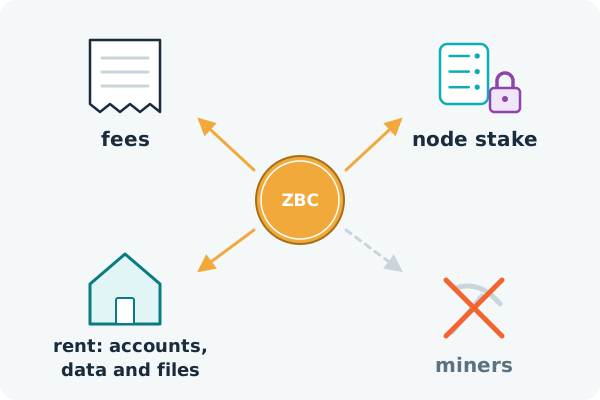
And ZBC is money: it moves by plain payment, escrow, stream or schedule (what you can do on ZooBC).
There are no miners to pay. Fees and new coins go to the registered nodes through the coinbase lottery, in proportion to their participation score.
Supply
Each chain has a supply ceiling of 33,333,333.33333333 ZBC (3,333,333,333,333,333 atomic units), counting everything credited at genesis and everything the coinbase will ever release. What the genesis does not hand out forms the coinbase pool, released over 15 years along a curve that is fastest at the start; after that no new ZBC is created (supply and emission). No rule destroys ZBC either: penalties and the dust of pruned accounts go to the longevity pool, which pays the nodes (ZBC is never burned).
On testnet, ZBC has no value, and anyone can get some free from the faucet (devnet, testnet and mainnet).